111.90.150.2044: 5 Essential Facts Explained
Is 111.90.150.2044 a Valid IP Address? Learn Why It Fails IPv4 Validation and What the Number 2044 Could Mean

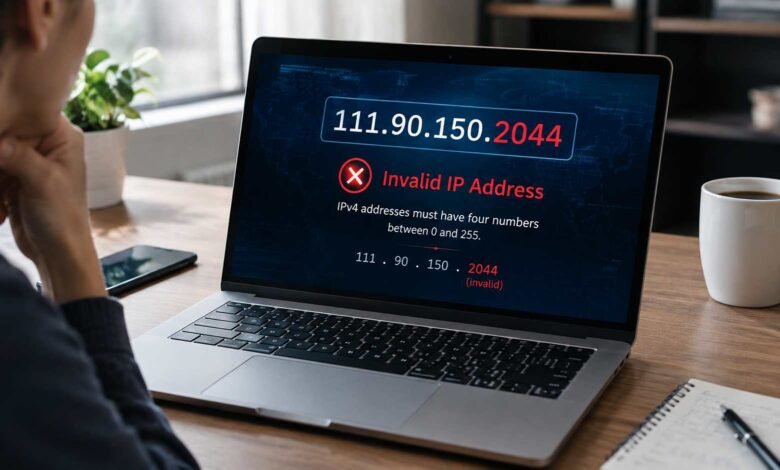
Seeing 111.90.150.2044 may make it look like an ordinary IP address. It is not a valid standard IPv4 address, because IPv4 uses four numeric components and each component must fit within the 0–255 range. The problem is the final component: 2044.
In simple terms, 111.90.150.2044 is a malformed IPv4-style string, not a normal public IP address. The first three sections, 111, 90, and 150, fall inside the normal range, but 2044 does not. That means you should not treat the full string as a valid IPv4 host address.
Key Takeaways
111.90.150.2044is not a valid standard IPv4 address.- IPv4 uses four octets, with each octet ranging from 0 to 255.
- The invalid part is the fourth section, 2044.
- The string may be the result of a typo, malformed data, or formatting problem, but the exact cause cannot be determined from the string alone.
- An IP address and a port number are different things.
- Do not assume this string identifies a hacker, person, or specific server.
- When you find it in logs, check the original source and surrounding characters before making a security decision.
Is 111.90.150.2044 a Valid IP Address?
No.
A standard IPv4 address contains four decimal components separated by periods. IPv4 addresses are 32 bits long, divided into four octets. In ordinary dotted-decimal notation, each octet must contain a value from 0 through 255.
Here is the string broken apart:
| IPv4 Section | Value | Valid Range | Result |
|---|---|---|---|
| First | 111 | 0–255 | Valid |
| Second | 90 | 0–255 | Valid |
| Third | 150 | 0–255 | Valid |
| Fourth | 2044 | 0–255 | Invalid |
The issue is therefore easy to identify. 2044 cannot be an IPv4 octet.
A strict IP parser will reject an address when one of its IPv4 components is above 255. Python’s current ipaddress documentation, for example, defines valid dotted IPv4 strings as four decimal integers in the inclusive 0–255 range.
Why Is 2044 Invalid in IPv4?
Each IPv4 octet is represented by eight bits. Eight bits can represent values from 0 to 255.
That gives the basic rule:
1 octet = 8 bits = 256 possible values = 0 through 255
So values such as:
010100192255
can appear as IPv4 octets.
A value such as:
2569992044
cannot.
That is why 111.90.150.2044 fails validation even though the first three sections look normal.
Could 111.90.150.2044 Be a Typo?
Yes, but there is no way to know the intended address from the string alone.
A common situation is that someone copies or types an address incorrectly. For example, a person could have intended a value such as:
111.90.150.204
That address has four components, and all four fall within the normal IPv4 range.
However, other possibilities exist. The intended value might have been different, or the text may have been generated by a software system that combined separate pieces of data.
The safest approach is to go back to the original source rather than guessing.
A Simple Verification Method
- Find the original log, message, configuration, screenshot, or application output.
- Copy the entire value again.
- Check whether the original contains punctuation that was removed.
- Compare the value with nearby entries.
- Run the suspected address through a proper IPv4 validator.
- Do not replace
2044with another number unless the source confirms it.
This is especially useful when investigating technical logs because guessing can lead you to inspect the wrong host.
Could 2044 Be a Port Number?
Possibly, but not in the way the string is currently written.
An IP address identifies a host. A port identifies a service endpoint associated with that host. In URI syntax, a port is separated from the host with a colon. RFC 3986 describes the port as an optional decimal value following the host and separated by :.
For example:
192.168.1.20:2044
Here:
- IP address:
192.168.1.20 - Port:
2044
That is structurally different from:
192.168.1.20.2044
The second version has five numeric-looking pieces and does not represent a normal IPv4 address plus a port.
This distinction matters because copying text from logs, screenshots, chat messages, or badly formatted reports can cause separators to disappear.
What Could Have Created 111.90.150.2044?
There is no authoritative record showing one specific origin for this exact malformed string. Several explanations are technically possible.
1. A Typing Error
The simplest explanation is a human typo.
An extra digit may have been added to an otherwise valid address.
2. Bad Data Formatting
Software may incorrectly combine fields when exporting, transforming, or displaying data.
For example, a logging system could produce malformed text when different values are joined together without the expected separator.
3. Copy-and-Paste Problems
A value copied from another application may lose punctuation or gain adjacent characters.
This is worth checking when the value appears in an email, spreadsheet, dashboard, or screenshot rather than a raw network record.
4. An Invalid User Input
An application may have accepted a string that looks like an IP address without properly validating it.
Good input validation should reject values that do not meet the required IPv4 format.
Python’s ipaddress module provides one example of strict validation by raising an error when the supplied value is not a valid IPv4 address.
Is 111.90.150.2044 a Security Threat?
The string itself is not enough evidence to call something malicious.
That distinction is important.
Finding an invalid IP-style value does not prove that you were attacked, scanned, hacked, or targeted. It may simply be bad data.
At the same time, context matters. If a malformed value appears repeatedly alongside failed login attempts, unusual requests, application errors, or other suspicious events, you may want to investigate the surrounding records.
The key is to analyze the actual event, not assign a threat label to the malformed string by itself.
What Should You Do if You See It in a Server Log?
Start with the raw record.
Look for:
- The full original line
- The timestamp
- The request path
- The user-agent or application context
- Nearby entries before and after it
- Any colon-separated port information
- The original source application
Then compare the malformed value with other records.
For example, suppose one line contains:
111.90.150.2044
but another nearby record contains:
111.90.150.204:443
That difference could provide a useful clue about how the malformed string was produced.
Do not block or investigate a specific host based only on a malformed string unless you have verified the actual address.
111.90.150.2044 vs. a Valid IPv4 Address
| Example | Standard IPv4? | Why |
|---|---|---|
111.90.150.2044 |
No | 2044 is above 255 |
111.90.150.204 |
Yes, structurally | All four components are within 0–255 |
192.168.1.1 |
Yes | Four valid IPv4 components |
8.8.8.8 |
Yes | Four valid IPv4 components |
300.10.10.10 |
No | 300 is above 255 |
The table shows why simply having four numbers separated by dots is not enough. Every individual component has to satisfy the IPv4 range rule.
Is 111.90.150.2044 a Public or Private IP?
It is neither in the normal IPv4 sense because it fails basic address validation first.
Private IPv4 space is defined in RFC 1918 and includes:
10.0.0.0/8172.16.0.0/12192.168.0.0/16
Those ranges can only be evaluated meaningfully after you have a valid IPv4 address.
Since 111.90.150.2044 is malformed, it should not be classified as a public or private IPv4 address.
Can This String Locate a Person?
No, not as written.
Because it is not a valid standard IPv4 address, normal IP lookup cannot reliably treat the complete string as an IPv4 host.
More broadly, IANA explains that assigned IP addresses can be looked up through the appropriate Regional Internet Registry to determine which network operator is responsible for an address block.
That is different from claiming that an IP address automatically reveals a person’s identity or exact physical location.
How to Check the Correct IP Address
When you suspect a typo, use a basic validation workflow.
- Count the sections.
A standard dotted IPv4 address has four sections. - Check every section.
Each dotted-decimal component should be between 0 and 255. - Check the original source.
Look for a missing colon, extra digit, or copied character. - Use a trusted validator.
A strict parser can tell you whether the value meets IPv4 syntax. - Use registry tools only after validation.
IANA provides IPv4 registry resources and points users toward the relevant regional registry for assigned addresses.
Python IPv4 address validation documentation
A Common Mistake to Avoid
A common misunderstanding is assuming that any four-part number separated by periods is an IP address.
That is not enough.
The value has to satisfy the actual IPv4 format rules. In this case, the problem is not the number of sections. There are four sections. The problem is that the fourth one is 2044, which is outside the valid octet range.
Another mistake is assuming that an unusual IP-looking string must be malicious. Without additional evidence, that conclusion goes beyond what the string tells you.
Final Verdict on 111.90.150.2044
111.90.150.2044 is not a valid standard IPv4 address. Its first three sections are acceptable, but the fourth section, 2044, is outside the 0–255 range required for an IPv4 octet.
The most useful next steps are:
- Check the original source to see whether the value was copied or typed incorrectly.
- Look for a missing separator, especially when the string came from a log or URL-like format.
- Validate any suspected corrected address before using IP lookup, blocking rules, or security decisions.
That approach keeps the investigation based on evidence instead of assumptions.
FAQs
Is 111.90.150.2044 a real IP address?
No. It is not a valid standard IPv4 address because the final component, 2044, exceeds the permitted 0–255 range.
What is wrong with 111.90.150.2044?
The fourth IPv4 component is 2044. An IPv4 octet must be between 0 and 255.
Could 111.90.150.2044 be a typo?
Yes. A typo is one possible explanation, but the intended value cannot be known without checking the original source.
Could 2044 be a port?
It could represent a port in another format, but a port normally appears after the host with a colon, such as 192.168.1.20:2044.
Can 111.90.150.2044 be traced?
Not as a normal IPv4 address because it fails standard IPv4 validation.
Is 111.90.150.2044 dangerous?
The malformed string alone does not prove malicious activity. Security decisions should be based on the surrounding event and verified network data.
What should I do if I found it in a server log?
Review the raw log entry, surrounding records, timestamps, separators, and related network data. Then validate the suspected address before taking action.
What is the likely correct IP?
One possibility is 111.90.150.204, but that is only a possibility. The original source should be checked before treating it as the intended address.