Packers vs Vikings Match Player Stats: 7 Key Takeaways
Complete Green Bay Packers vs Minnesota Vikings Player Stats, Box Score, Passing, Rushing and Receiving Leaders

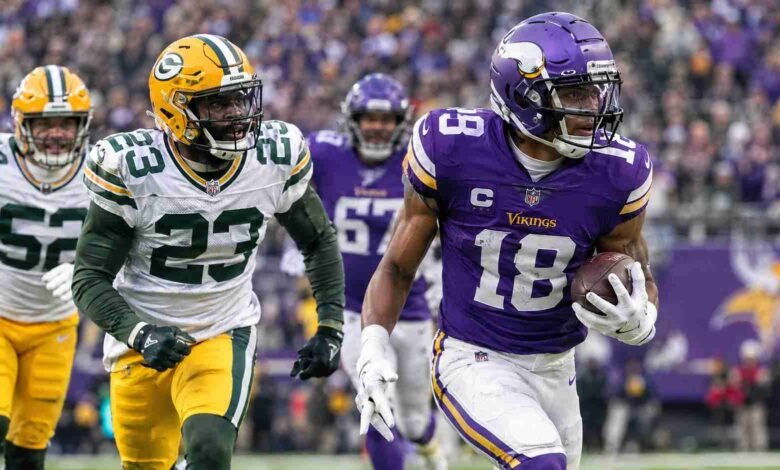
The Green Bay Packers vs Minnesota Vikings match player stats from January 4, 2026, tell a much different story than a typical NFC North matchup. Minnesota won 16-3 at U.S. Bank Stadium after holding Green Bay to just 121 total yards, while the Vikings produced 363 yards. Justin Jefferson led all receivers with 8 catches for 101 yards, Jordan Mason rushed for 94 yards, and J.J. McCarthy passed for 182 yards.
Quick answer: Minnesota controlled the game with 363 total yards to Green Bay’s 121. J.J. McCarthy completed 14 of 23 passes for 182 yards, Jordan Mason ran 14 times for 94 yards, and Justin Jefferson caught 8 of 11 targets for 101 yards. Green Bay quarterback Clayton Tune finished 6 of 11 for 34 yards and was sacked four times.
Key Takeaways
- Minnesota won 16-3 on January 4, 2026.
- The Vikings gained 363 total yards, compared with 121 for Green Bay.
- J.J. McCarthy passed for 182 yards and posted an 85.8 passer rating.
- Justin Jefferson had 8 receptions for 101 yards on 11 targets.
- Jordan Mason led the game in rushing with 94 yards on 14 carries.
- Clayton Tune completed 6 of 11 passes for 34 yards and took four sacks.
- Minnesota finished 21 of 31 passing for 239 yards as a team, while Green Bay managed only 34 gross passing yards.
Packers vs Vikings Final Score
| Team | Q1 | Q2 | Q3 | Q4 | Final |
|---|---|---|---|---|---|
| Green Bay Packers | 0 | 0 | 0 | 3 | 3 |
| Minnesota Vikings | 3 | 10 | 0 | 3 | 16 |
Minnesota built a 13-0 halftime lead through three field goals and a 1-yard touchdown run by C.J. Ham. The Packers did not get on the board until the final play of the game, when Brandon McManus made a 24-yard field goal.
The game was played at U.S. Bank Stadium in Minneapolis with an attendance of 66,606.
Team Stats Comparison
| Statistic | Packers | Vikings |
|---|---|---|
| Total yards | 121 | 363 |
| First downs | 12 | 23 |
| Rushing yards | 128 | 137 |
| Passing yards | -7 net | 226 net |
| Passing | 6/11 | 21/31 |
| Third down | 3/12 | 2/10 |
| Time of possession | 26:30 | 33:30 |
| Sacks allowed | 4 | 2 |
| Turnovers | 0 | 1 |
The widest gap was total offense. Minnesota generated three times as many yards as Green Bay, while also holding the ball for 33:30. The Packers actually ran for 128 yards, but their passing offense collapsed under pressure, leaving them with -7 net passing yards after sacks.
That split is important when reading the box score. Green Bay was not completely shut down on the ground. The bigger problem was a passing attack that produced just 34 gross yards while taking four sacks for 41 yards.
Packers Passing Stats
Clayton Tune started at quarterback for Green Bay and completed 6 of 11 attempts for 34 yards, with no touchdowns or interceptions. His passer rating was 60.4. He also ran four times for 23 yards.
Green Bay Passing
| Player | C/ATT | Yards | TD | INT | Sacks | Rating |
|---|---|---|---|---|---|---|
| Clayton Tune | 6/11 | 34 | 0 | 0 | 4 | 60.4 |
Tune’s numbers need some context. Green Bay rested many starters for the finale, and the Packers’ official recap noted that backups played against Minnesota’s starters.
Packers Rushing Leaders
| Player | Carries | Yards | Average | TD |
|---|---|---|---|---|
| Chris Brooks | 13 | 61 | 4.7 | 0 |
| Emanuel Wilson | 18 | 44 | 2.4 | 0 |
| Clayton Tune | 4 | 23 | 5.8 | 0 |
Chris Brooks led Green Bay in rushing with 61 yards, while Emanuel Wilson carried the ball 18 times for 44 yards. Green Bay finished with 128 rushing yards as a team.
Vikings Passing Stats
J.J. McCarthy started for Minnesota and completed 14 of 23 passes for 182 yards without a touchdown or interception. He finished with an 85.8 passer rating and added 7 rushing yards.
Max Brosmer took over later and completed 7 of 8 passes for 57 yards, giving Minnesota a combined 239 passing yards.
Minnesota Passing
| Player | C/ATT | Yards | TD | INT | Rating |
|---|---|---|---|---|---|
| J.J. McCarthy | 14/23 | 182 | 0 | 0 | 85.8 |
| Max Brosmer | 7/8 | 57 | 0 | 0 | 96.4 |
Vikings Rushing Stats
Jordan Mason was Minnesota’s top runner. He gained 94 yards on 14 carries, averaging 6.7 yards per attempt and producing a 24-yard long run.
| Player | Carries | Yards | Average | TD |
|---|---|---|---|---|
| Jordan Mason | 14 | 94 | 6.7 | 0 |
| Ty Chandler | 10 | 23 | 2.3 | 0 |
| Zavier Scott | 3 | 9 | 3.0 | 0 |
| J.J. McCarthy | 2 | 7 | 3.5 | 0 |
| Justin Jefferson | 1 | 3 | 3.0 | 0 |
| C.J. Ham | 1 | 1 | 1.0 | 1 |
C.J. Ham supplied the game’s only touchdown, scoring on a 1-yard rushing attempt.
Packers Receiving Stats
Green Bay’s passing game never found much rhythm. Jakobie Keeney-James was the team’s leading receiver by both catches and yards, finishing with 2 receptions for 15 yards.
| Player | Targets | Receptions | Yards | TD |
|---|---|---|---|---|
| Jakobie Keeney-James | 2 | 2 | 15 | 0 |
| Matthew Golden | 3 | 1 | 8 | 0 |
| Josh Whyle | 1 | 1 | 4 | 0 |
| Emanuel Wilson | 1 | 1 | 4 | 0 |
| Drake Dabney | 2 | 1 | 3 | 0 |
| Bo Melton | 1 | 0 | 0 | 0 |
The Packers completed only six passes in the game and totaled 34 passing yards before sack losses.
Vikings Receiving Stats
Justin Jefferson was the clear standout among the pass catchers.
He finished with 8 receptions on 11 targets for 101 yards, including an 18-yard long reception. His performance also pushed his season total over 1,000 receiving yards.
| Player | Targets | Receptions | Yards | TD |
|---|---|---|---|---|
| Justin Jefferson | 11 | 8 | 101 | 0 |
| J.J. McCarthy | 0 | 0 | 0 | 0 |
| C.J. Ham | 1 | 1 | 6 | 0 |
| Ty Chandler | 4 | 3 | 11 | 0 |
| Zavier Scott | 1 | 1 | 8 | 0 |
Jefferson’s performance was significant because Minnesota did not need a passing touchdown to win. The Vikings paired his receiving production with Mason’s rushing work and a strong defensive outing.
Defensive Player Stats That Stood Out
Minnesota’s defense allowed only 121 total yards and recorded four sacks. The unit also held Green Bay to 3-for-12 on third down.
Green Bay’s defense also created a key takeaway in the red zone. Brenton Cox Jr. recorded a sack and forced fumble, while Barryn Sorrell recovered the ball. Sorrell also recorded another sack and finished with eight tackles.
Cox’s official team profile credits him with two tackles, one sack, one forced fumble, one tackle for loss, three quarterback hits and five quarterback pressures in the game.
Dallas Turner was the top Minnesota pass rusher with two sacks, according to the game coverage.
Seven Numbers That Tell the Story
Sometimes the quickest way to understand this game is to strip it down to a few numbers:
- 363 total yards for Minnesota.
- 121 total yards for Green Bay.
- 182 passing yards for J.J. McCarthy.
- 94 rushing yards for Jordan Mason.
- 101 receiving yards for Justin Jefferson.
- 4 sacks taken by Clayton Tune.
- 16-3 final score.
These numbers show why the Vikings controlled the game even without throwing a touchdown. They moved the ball more consistently, protected their quarterback better, and limited Green Bay’s passing attack.
A Common Misunderstanding About the Box Score
One easy mistake is assuming the game reflects the normal 2025 Packers starting offense.
It does not.
The Packers’ official recap states that Green Bay rested as many starters as possible because the team had already secured a playoff spot. That is why Clayton Tune started at quarterback instead of Jordan Love, and why the offensive numbers look very different from Green Bay’s standard lineup.
That context should be included whenever these player stats are compared with the teams’ season averages.
What These Packers vs Vikings Stats Mean
The 16-3 result was not simply a case of Minnesota getting one big play. The Vikings controlled the game across several areas.
Their offense gained 137 rushing yards and 226 net passing yards. Green Bay’s run game was respectable at 128 yards, but the passing attack produced just 34 gross yards and lost 41 yards on sacks.
Minnesota also managed to keep the Packers off the scoreboard until the final play. That combination of field-position control, defensive pressure and balanced offense explains the final margin better than the score alone.
Conclusion
The latest completed Green Bay Packers vs Minnesota Vikings match player stats show a clear Minnesota advantage in the January 4, 2026 matchup.
Justin Jefferson was the leading receiver with 101 yards, Jordan Mason led the ground game with 94 rushing yards, and J.J. McCarthy produced 182 passing yards. Green Bay’s offense struggled to generate passing yards with Clayton Tune under center, finishing with 121 total yards.
For readers comparing these teams, the three most useful next steps are to check the individual player tables, compare the team-level yardage, and keep the Packers’ decision to rest starters in mind when judging the offensive numbers.
FAQs
What was the final score of Packers vs Vikings on January 4, 2026?
The Minnesota Vikings beat the Green Bay Packers 16-3 at U.S. Bank Stadium.
Who was the Packers’ starting quarterback?
Clayton Tune started for Green Bay and completed 6 of 11 passes for 34 yards, with no touchdowns or interceptions.
How many yards did J.J. McCarthy pass for against the Packers?
J.J. McCarthy passed for 182 yards on 14-of-23 passing.
How many receiving yards did Justin Jefferson have against Green Bay?
Justin Jefferson recorded 101 receiving yards on 8 catches and 11 targets.
Who led the Vikings in rushing?
Jordan Mason led Minnesota with 94 rushing yards on 14 carries.
Who scored the Vikings’ only touchdown?
C.J. Ham scored Minnesota’s only touchdown on a 1-yard rushing play.
How many total yards did the Vikings have?
Minnesota finished with 363 total yards, compared with 121 for Green Bay.
Why did the Packers use Clayton Tune?
Green Bay rested many starters in the regular-season finale after securing a playoff place, so Tune started at quarterback against Minnesota.