Universal Credit Payment Dates April 2026 UK: Full Easter Schedule
Millions of people across Britain are preparing for a busy financial month. Understanding your Universal Credit payment dates April 2026 UK is essential for effective budgeting. This month is particularly complex due to the timing of the Easter bank holidays and the start of the new financial year.
The Department for Work and Pensions (DWP) usually pays Universal Credit every month. However, bank holidays often disrupt this regular schedule. When a payment date falls on a holiday or a weekend, the DWP moves the payment forward. This ensures you receive your funds before the break begins.
In addition to date changes, April 2026 marks the arrival of new benefit rates. Most claimants will see a modest increase in their standard allowance. This guide explains when you will be paid and what changes to expect in your statement.
How the Easter Bank Holidays Affect You
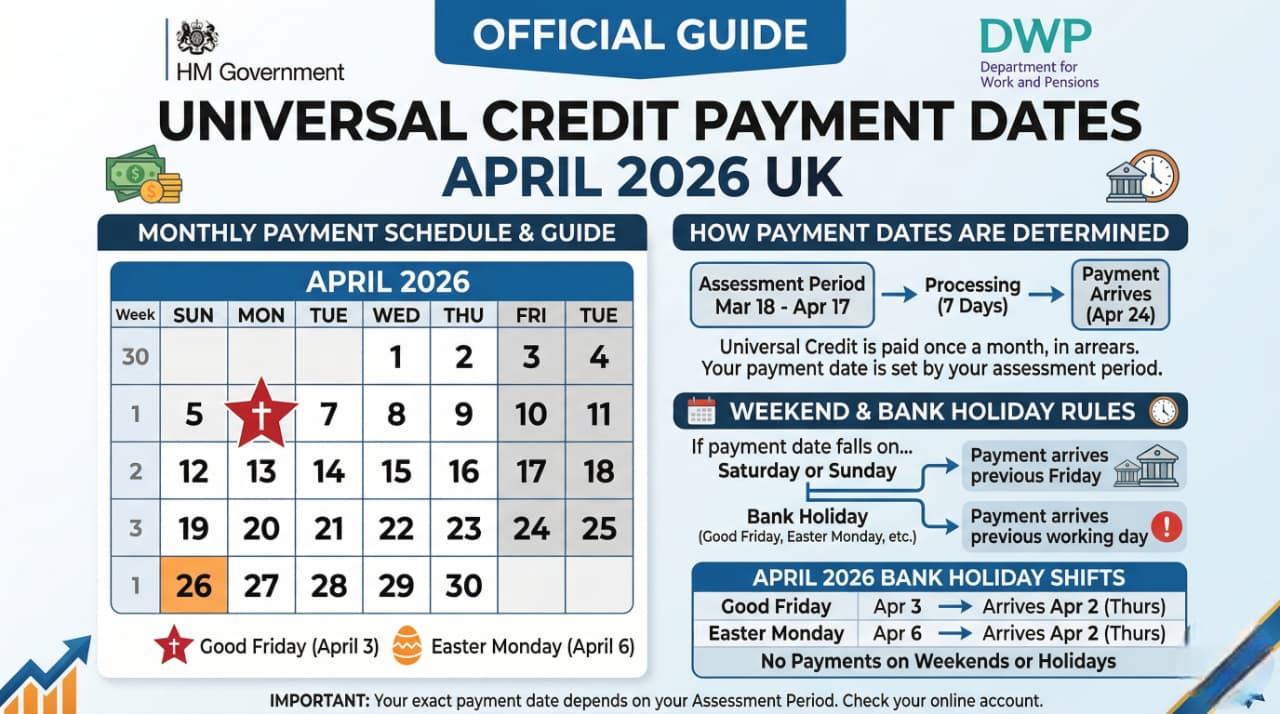
The most significant factor for Universal Credit payment dates April 2026 UK is the Easter weekend. In 2026, Easter arrives at the very start of April. This means many people who usually receive their money in the first week of the month will see a shift.
Good Friday falls on 3 April 2026. This is followed by Easter Monday on 6 April 2026. Because banks and DWP offices are closed on these days, payments cannot be processed normally. If your usual payment date falls between the 3rd and the 6th of April, your money will arrive early.
Usually, the DWP pays claimants on the last working day before the holiday starts. For the Easter 2026 period, this means many payments will land in accounts on Thursday, 2 April. While receiving money early feels like a bonus, it requires careful planning for the month ahead.
The Official April 2026 Payment Schedule
To help you plan, we have compiled a likely schedule for Universal Credit payment dates April 2026 UK. These dates follow the standard DWP protocols for bank holidays. If you are unsure, you can always check your online Universal Credit journal for your specific statement.
| If your payment is due on: | You will likely be paid on: |
| Friday 3 April (Good Friday) | Thursday 2 April |
| Saturday 4 April | Thursday 2 April |
| Sunday 5 April (Easter Sunday) | Thursday 2 April |
| Monday 6 April (Easter Monday) | Thursday 2 April |
| Tuesday 7 April onwards | Normal scheduled date |
After the Easter weekend, payments should return to their regular schedule. For example, if your payment is due on Friday 10 April, you should receive it on that day as normal. There are no other major bank holidays in April 2026 to cause further delays.
[Check official DWP benefit payment rules on GOV.UK]
New Universal Credit Rates for 2026/2027
April is not just about changing dates; it is also about the annual “uprating” of benefits. From 6 April 2026, the DWP will implement new rates for the 2026/27 tax year. These increases are generally linked to inflation figures from the previous September.
For many households, the standard allowance is increasing by approximately 3.8%. This reflects the Consumer Prices Index (CPI) from late 2025. While the increase may seem small, it provides vital support during periods of high living costs. Here is a breakdown of the new monthly standard allowances:
Single (under 25): Increased to £338.58
Single (25 or over): Increased to £424.90
Joint claimants (both under 25): Increased to £528.34
Joint claimants (one or both 25 or over): Increased to £666.97
These new rates will apply to the first full assessment period that starts on or after 6 April. Therefore, you might not see the higher amount in your very first April payment. Most people will see the increase reflected in their May statement.
Major Policy Changes in April 2026
April 2026 is a milestone for several major policy shifts. One of the most discussed changes is the potential removal of the “two-child limit.” Under previous rules, parents could only claim additional elements for their first two children.
Starting this month, the government is expected to extend support to larger families. This means you may receive a child element for every child in your household, regardless of when they were born. This change could significantly boost the monthly income of thousands of families across the UK.
Additionally, changes to the “Limited Capability for Work” elements are taking effect. New claimants with health conditions may see different award tiers compared to previous years. Always check your journal for messages from your work coach regarding these specific updates.
Budgeting for the “Easter Gap”
While receiving your money early on 2 April is helpful, it creates a longer gap. Your next payment will likely not arrive until your regular date in May. This means your April funds must last several days longer than usual.
To manage this, try to set aside money for essential bills as soon as your payment arrives. Transitioning into the new tax year can also coincide with increases in council tax or utility bills. Planning early helps you avoid a financial shortfall toward the end of the month.
Many people find it useful to use a budgeting app or a simple spreadsheet. List your fixed costs first, such as rent and energy. Then, allocate what remains for food and travel. Remember that the early Easter payment is not extra money; it is simply your regular payment paid sooner.
What to Do If Your Payment Is Late
If your Universal Credit payment dates April 2026 UK pass and you haven’t received your money, do not panic. First, double-check your online account. The “Payments” section will show exactly how much you were sent and when.
If the money is missing, contact the Universal Credit helpline immediately. You can reach them at 0800 328 5644. It is often faster to send a message through your online journal first. Work coaches can often see if there is a technical delay with your specific claim.
Sometimes, a payment is delayed because you haven’t reported a change in circumstances. Ensure your housing costs, earnings, and childcare details are all up to date. If you are in urgent financial distress, you can ask for an “Advance Payment” or a “Hardship Payment.”
[Get help with Universal Credit from Citizens Advice]
Conclusion
Staying informed about Universal Credit payment dates April 2026 UK is the best way to maintain financial stability. The combination of the Easter holidays and new 2026/27 rates makes this a pivotal month for claimants.
By checking the schedule early, you can prepare for the 2 April shift. Ensure you are aware of the new standard allowance amounts to understand how your income will change. Most importantly, budget carefully for the long gap between your April and May payments.
The DWP continues to modernise the system, but bank holidays remain a fixed point in the calendar. Keep your online journal updated and stay in touch with your work coach. This proactive approach will help you navigate the changes in April 2026 with confidence.
FAQs
When will I be paid Universal Credit over Easter 2026?
If your payment is due on Good Friday (3 April) or Easter Monday (6 April), you will likely be paid on Thursday, 2 April 2026. This is the last working day before the holiday weekend.
Are Universal Credit rates going up in April 2026?
Yes, most benefit rates will increase from 6 April 2026. The standard allowance for a single person over 25 is expected to rise to approximately £424.90 per month.
Why is my April Universal Credit payment lower than expected?
New rates only apply to assessment periods starting on or after 6 April. If your assessment period began in March, you will still receive the old rate for your April payment.
What are the Universal Credit payment dates April 2026 UK for weekends?
If your payment date falls on Saturday 4 April or Sunday 5 April, the DWP will move it forward. You should receive your payment on Thursday, 2 April, along with the Friday and Monday claimants.
Is the two-child limit being removed in April 2026?
Major updates to the child element rules are scheduled for April 2026. Many families with three or more children will see an increase in their monthly award as the limit is lifted.